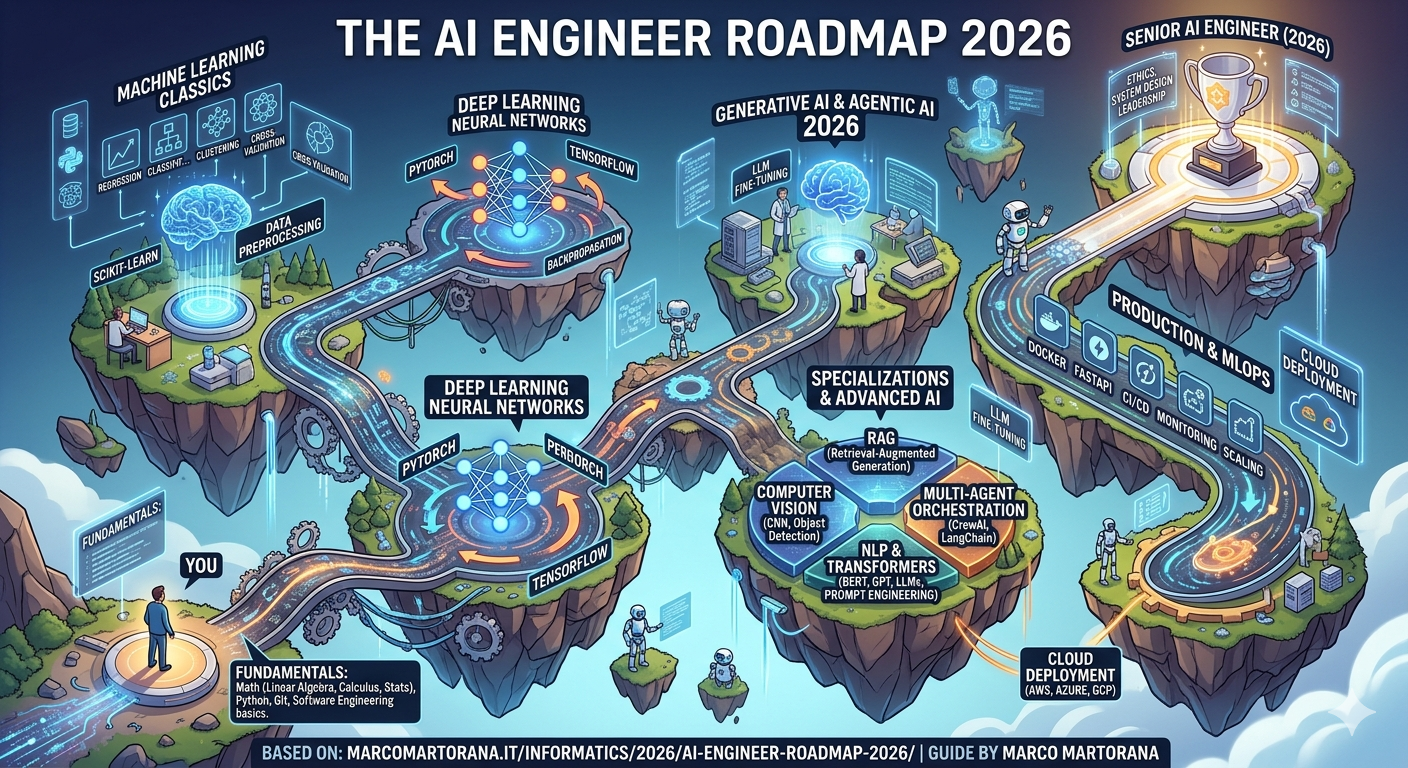
🚀 The 2026 AI Engineer Roadmap (Agent-Focused)
A practical guide for anyone looking to build a solid career in AI engineering. This roadmap is built around real products, agent systems, and product-oriented thinking.
💡 Key premise: AI Engineer ≠ model training. It’s about building useful, working products, starting from user problems, not technological hype.
🧠 Phase 0 — Shift Your Mindset
Before writing code, it’s essential to adopt the right mindset:
| ❌ Old Mindset | ✅ New Mindset |
|---|---|
| “I need to learn model training” | “I need to build useful products” |
| “I start from the hottest technology” | “I start from user problems” |
| “I’m an ML researcher” | “I’m a software engineer + AI” |
| “Endless tutorials” | “Real projects and impact” |
The modern AI Engineer is a hybrid: combining solid software engineering foundations with the ability to integrate AI systems into working products.
🟢 Phase 1 — Foundations (0–2 Months)
The non-negotiable basics. Without these, everything else is built on sand.
Key Skills
- Python — Clean code, OOP, modular design
- APIs & HTTP — REST, JSON, request handling
- Git & Version Control — Branching, merging, collaborative workflows
- Core ML Concepts — Supervised/unsupervised learning, overfitting, evaluation metrics
- Basic Statistics — Distributions, probability, inference
Recommended Projects
- Python scripts for automating daily tasks
- Simple REST APIs with Flask/FastAPI
- Exploratory analysis of public datasets (Kaggle)
⏱️ Estimated time: 2 months with consistent study (10-15 hours/week)
🟡 Phase 2 — LLM Application Development (2–4 Months)
This is where modern AI engineering gets real: building applications that leverage Large Language Models.
Key Skills
| Area | What to Learn |
|---|---|
| LLM APIs | OpenAI, Anthropic, Google Vertex AI |
| Prompt Engineering | Zero-shot, few-shot, chain-of-thought, ReAct |
| Embeddings | Concepts, models (text-embedding, BGE, E5) |
| Vector Databases | Pinecone, Weaviate, Qdrant, pgvector |
| RAG | Retrieval-Augmented Generation, chunking strategies |
Projects to Build
- Specialized Chatbot — Assistant for a specific domain (e.g., recipes, fitness, study)
- Document Q&A — System that answers questions from PDFs or company documents
- Content Tools — Content generators (blog posts, emails, social media)
⏱️ Estimated time: 2-4 months. This is where your first “serious” showcase project comes from.
🔵 Phase 3 — Agent Engineering (4–8 Months)
The frontier of AI engineering: autonomous systems that plan, reason, and act.
Key Skills
- Agent Design — Tools, memory, planning loops
- Frameworks — LangGraph, CrewAI, AutoGen, LlamaIndex Agents
- Structured Workflows — Orchestrating multi-step tasks
- LLM + Code — Having agents write and execute code
Projects to Build
- Multi-Agent System — Team of specialized agents (e.g., researcher + writer + editor)
- Personal Assistant — Agent that plans tasks, manages calendar, searches information
- Workflow Automation — Business process automation (e.g., lead qualification, customer support)
# Conceptual example: Agent with tools
from langgraph import StateGraph

class ResearchAgent:
    def __init__(self):
        self.tools = [SearchTool(), CalculatorTool(), FileTool()]

    def plan(self, task: str) -> list:
        # LLM generates an action plan
        pass

    def execute(self, plan: list) -> str:
        # Executes steps by calling appropriate tools
        pass
⏱️ Estimated time: 4-8 months. This is where you build your differentiating portfolio.
🟣 Phase 4 — Advanced AI Systems (6–12 Months)
For those who want to move from “building apps” to “building robust, reliable systems”.
Key Skills
| Area | Details |
|---|---|
| LLM Internals | Transformers, attention, tokenization |
| Advanced RAG | Hybrid search, reranking, query expansion |
| Evaluation | Hallucination detection, faithfulness, relevance metrics |
| Observability | Tracing, logging, debugging (LangSmith, Arize, Phoenix) |
| Reliability | Retry strategies, fallbacks, guardrails |
Projects to Build
- RAG system with hybrid search (keyword + semantic)
- Automated evaluation pipeline for AI responses
- Monitoring and tracing dashboard for production agents
⏱️ Estimated time: 6-12 months. This phase separates juniors from mid/senior engineers.
🔴 Phase 5 — Production AI (1+ Year)
Deploying AI systems to production is a challenge of its own. This is where you learn to manage scalability, costs, and security.
Key Skills
- Deployment — Docker, Kubernetes, cloud platforms (AWS, GCP, Azure)
- CI/CD for AI — Testing, model versioning, deployment pipelines
- Optimization — Latency reduction, cost management, caching, batching
- Security — Prompt injection, data leaks, PII handling, rate limiting
Production Pattern
┌─────────────────────────────────────────────────────────┐
│                    Production AI Stack                   │
├─────────────────────────────────────────────────────────┤
│  Load Balancer → API Gateway → Rate Limiter → Auth     │
│                      ↓                                  │
│  [Cache Layer] → [LLM Router] → [Fallback Models]       │
│                      ↓                                  │
│  [Observability: Logs, Traces, Metrics, Alerts]         │
└─────────────────────────────────────────────────────────┘
⏱️ Estimated time: 1+ year. You learn this in the field, managing real systems.
✨ Bonus — Portfolio That Stands Out
Tutorials aren’t enough. Here’s how to stand out:
| Strategy | Why It Works |
|---|---|
| 3-5 real projects | Demonstrates end-to-end capability, not just theory |
| Turn ideas into demos/SaaS | Shows product thinking, not just coding |
| Share publicly | Building in public attracts opportunities and feedback |
| Prioritize impact | One used project > 10 completed tutorials |
Examples of “Portfolio-Worthy” Projects
- AI Assistant for a specific niche (e.g., lawyers, doctors, real estate agents)
- Micro SaaS — Paid tool for a specific problem (e.g., cold email generator)
- Open Source Library — Utility for the AI community (e.g., eval framework, prompt templates)
- Detailed Case Study — Document an end-to-end project with metrics and lessons learned
📊 Summary Table
| Phase | Duration | Key Skills | Expected Output |
|---|---|---|---|
| Phase 0 | Weeks | Mindset, foundations | Clarity on the path |
| Phase 1 | 0-2 months | Python, APIs, Git, ML basics | Working scripts and APIs |
| Phase 2 | 2-4 months | LLM APIs, RAG, Embeddings | Chatbots, Document Q&A |
| Phase 3 | 4-8 months | Agents, LangGraph, CrewAI | Multi-agent systems |
| Phase 4 | 6-12 months | Advanced RAG, Eval, Observability | Robust, monitored systems |
| Phase 5 | 1+ year | Production, CI/CD, Security | Systems in production |
Conclusion
This roadmap isn’t a rigid linear path. It’s a mental map for navigating a rapidly evolving field.
Guiding Principles
- Build immediately — Don’t wait to “know everything.” Start with small projects.
- Learn by doing — Apply every concept immediately.
- Document your journey — Write, share, teach what you learn.
- Adapt, don’t follow blindly — Customize the roadmap based on your goals.
🎯 End goal: Not becoming “an AI expert,” but building products that solve real problems.
Happy journey! 🚀
If you find this roadmap useful, share it with someone starting their journey. Knowledge sharing is the best way to solidify what you learn.

Use the share button below if you liked it.
It makes me smile, when I see it.